Objective
Problem
Solution
Process
Outcome
Next Steps

Intelligent Sector Classification for Retail Investing | Revolut Pitch

Concept presented to Revolut as part of a potential partnership initiative. Not publicly launched.

Outcome

Concept submitted; not pursued. Framed as a learning‑oriented exploration that produced a reusable integration blueprint for EU fintech partners.

Role: Product Designer (UX/UI), external partner pitch
Team:
CEO, COO, Sales, Design
Timeline:
Spring 2025

Objective

I explored how our Dynamic Company Sector Classification (DCSC) and multi‑level taxonomy could strengthen a Revolut‑style investing experience.

The goal was to shorten the path from theme → discovery → allocation, while improving transparency and control.

Why this matters to European product orgs

  • Supports thematic investing while keeping methodology transparent and readable.
  • Designed to fit European regulatory expectations (clear risk language, methodology explainer) and GDPR‑sensitive handling (no PII required for core features, opt‑in analytics).
  • Built to slot into existing design systems with minimal re‑theming and easy localization (labels, numbers, dates).
Problem

Problem & Opportunity

Pain points I targeted

  • Discovery pain: Users think in themes, but must research across sources to find relevant companies.
  • Transparency gap: True exposure by sector is hard to see beyond a single label.
  • Action gap: Even with ideas, allocating across a theme is fiddly and time‑consuming.

Opportunity

Use DCSC’s L1–L4 taxonomy and a Relevance score to:

  1. find companies aligned with a theme, 2) reveal composition & concentration, and 3) enable guided allocation.
Solution

Solution (Three Modules)

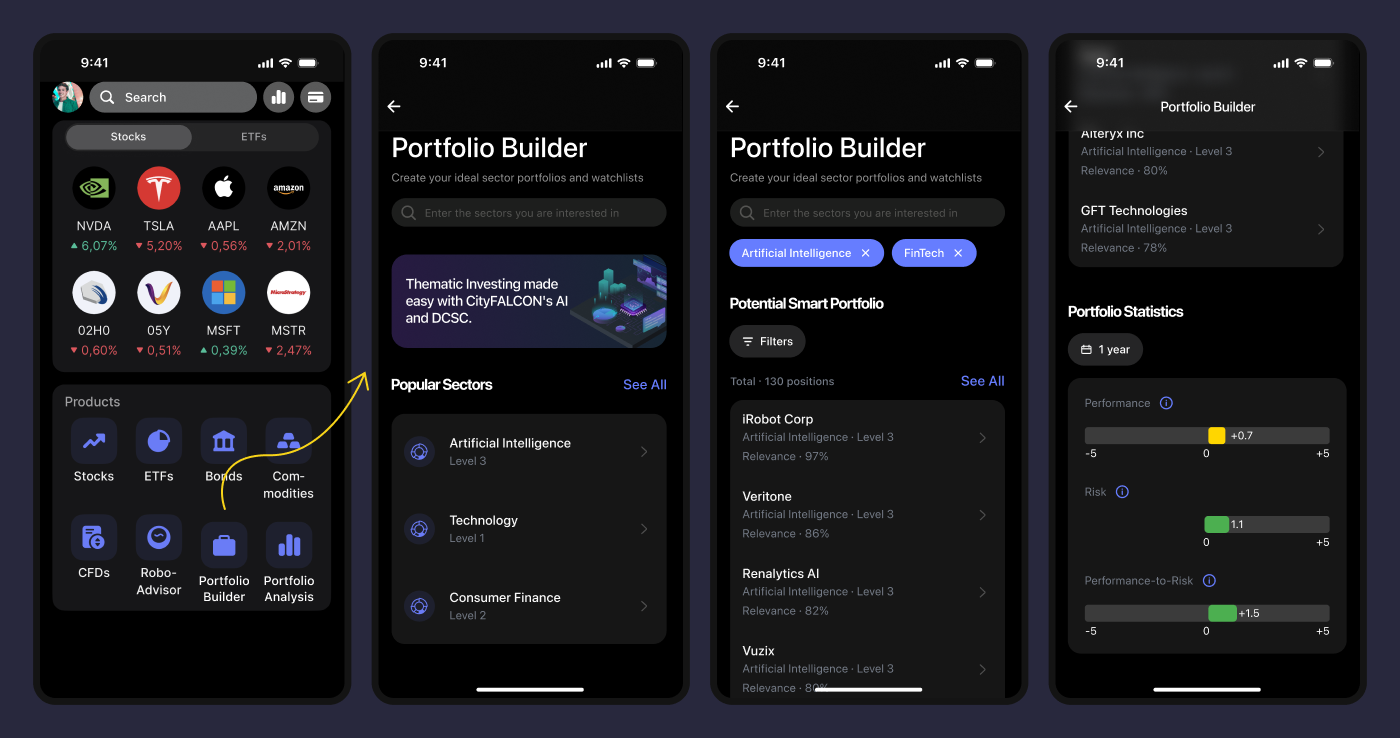
A. Portfolio Builder

  • Input: pick themes/sectors or type your own; start from popular lists.
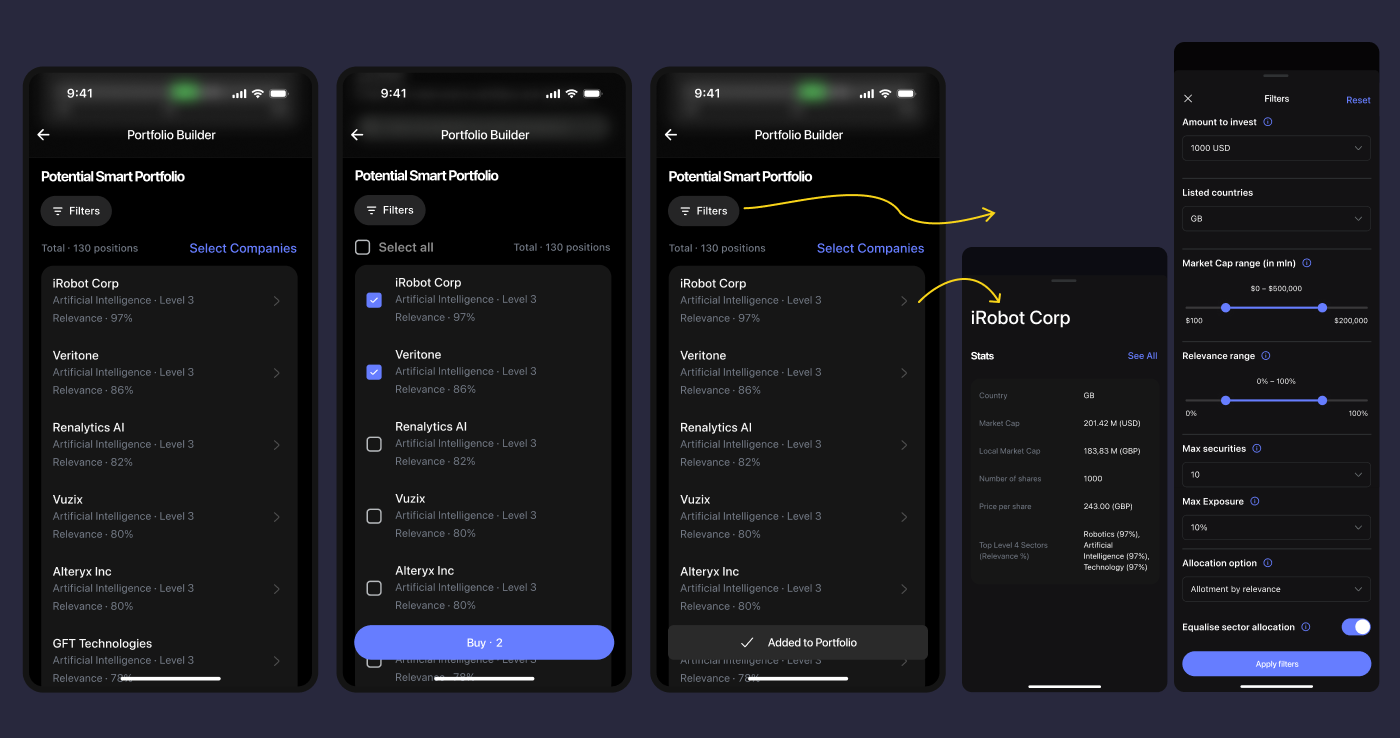
  • Output: a curated, relevance‑ranked list of companies (public/private toggle).
  • Controls: Market cap, country, relevance, max securities, max exposure; allocation by relevance or equal weight.
  • Feedback: Inline portfolio stats and a short loop: Add → Cap exposure → Allocate.
Portfolio Builder

B. Portfolio Analysis
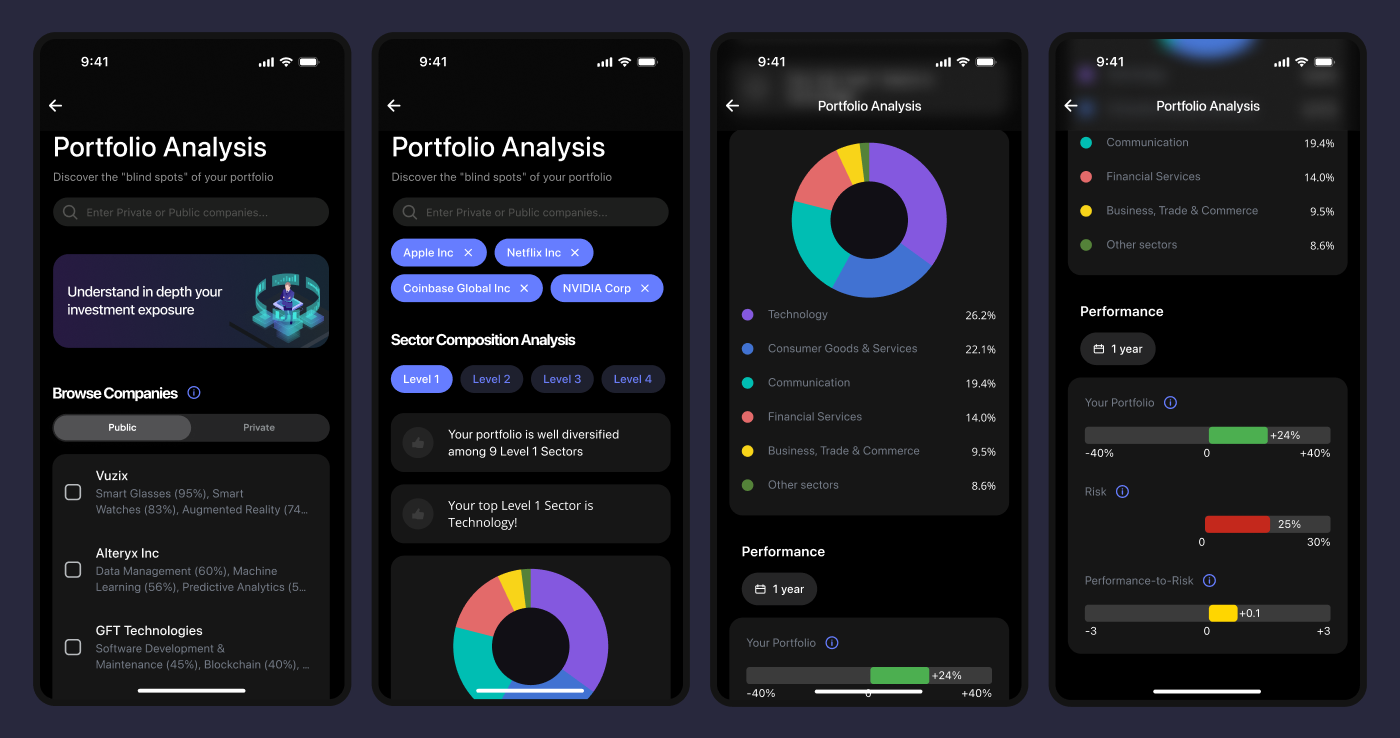
  • Composition: Multi‑level sector breakdown (L1–L4) with top‑sector callouts and blind‑spot flags.
  • Signals: Performance, risk, and performance‑to‑risk for quick comparison.
Portfolio Analysis

C. Instrument Sector Panel
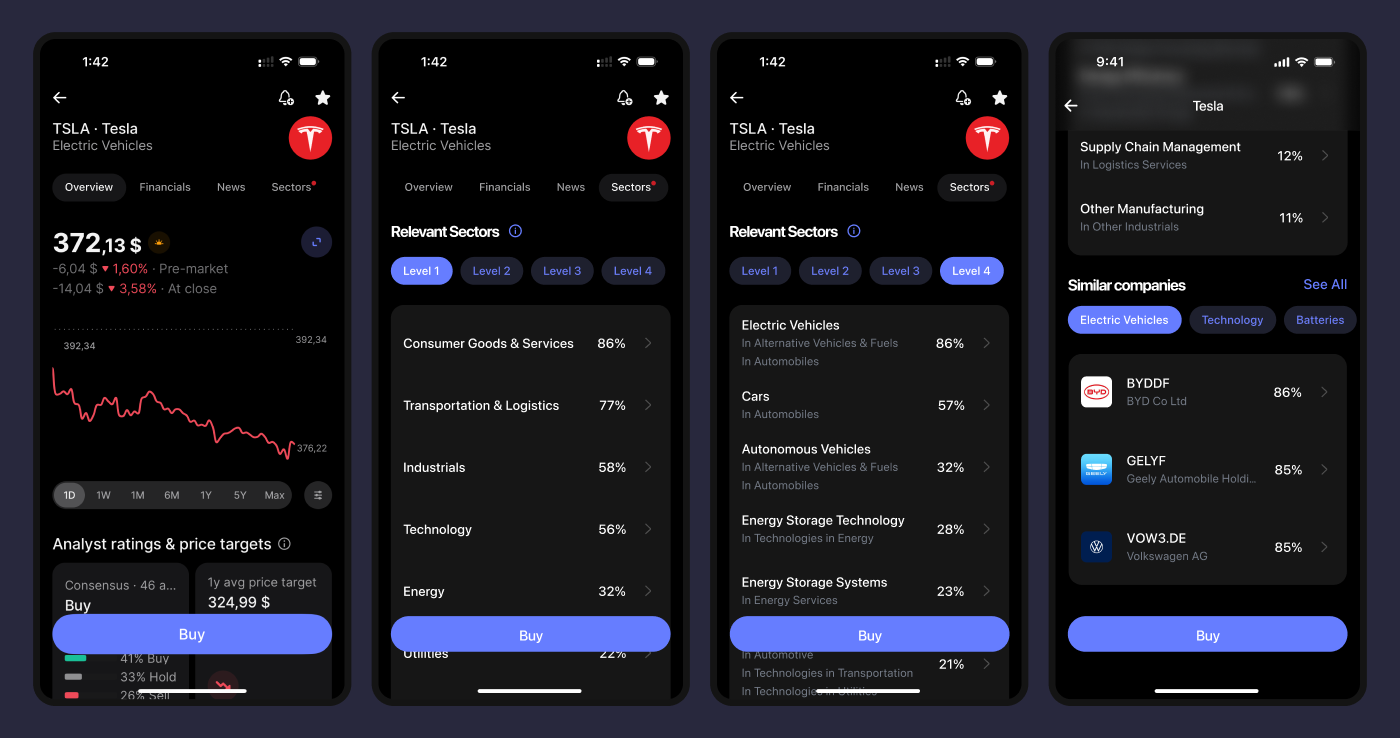
  • For any stock, surface sector weights and similar companies by sector overlap to speed idea exploration.
Progressive disclosure; clear explanations for Relevance; portable components; localization‑friendly copy; compact mobile behaviors.

Process

Process & Key Decisions

  • Mental model: Let users start from themes, not tickers; keep Relevance first‑class (sorting, badges, allocation).
  • Key decisions: Levelled taxonomy (L1–L4), a short discovery → action loop, and a consistent metric trio (performance, risk, performance‑to‑risk).
  • Trust surface: Add a "What is Relevance?" explainer and data timestamping near controls.
  • Integration blueprint: Where the feature can live (Watchlists, Portfolio creation, Details), event hooks, and ownership of computation vs. storage.
  • Pitch storyline: Idea → ranked list → filters → add → allocate → analyse, with a light technical slide for effort and analytics.

Outcome

Outcome & Learnings

Although not pursued, the pitch hardened our integration patterns, clarified the data‑to‑UI contract, and produced a reusable partner story.

What worked: The two‑module story (Builder + Analysis), relevance‑driven allocation, and multi‑level composition.

What I’d tighten next time for EU orgs:

  • Make the pilot plan explicit (markets, audience size, duration, responsibilities).
  • Bring methodology & risk copy earlier (MiFID‑aligned disclaimers, plain language).
  • Quantify expected business outcomes (activation lift, AUM influenced, retention via portfolio stickiness).

Next Steps & Success Metrics (Pilot‑ready)

Scope: 2–3 themes (e.g., AI, Clean Energy, FinTech) in 1–2 EU markets; 4–6 weeks; targeted retail cohort.

Primary KPIs: time‑to‑portfolio, add‑to‑portfolio rate, avg. positions per theme, diversification index, revisit rate; secondary: AUM influenced.

Rollout plan: limited A/B, then gated expansion; measure lift vs. control; publish a short methodology note.

Risks & mitigations: data trust (explainers, timestamps), over‑selection (caps & presets), brand fit (modular components).

Objective
Problem
Solution
Process
Outcome
Next Steps

Intelligent Sector Classification for Retail Investing | Revolut Pitch

Concept presented to Revolut as part of a potential partnership initiative. Not publicly launched.

Outcome

Concept submitted; not pursued. Framed as a learning‑oriented exploration that produced a reusable integration blueprint for EU fintech partners.

Role: Product Designer (UX/UI), external partner pitch
Team:
CEO, COO, Sales, Design
Timeline:
Spring 2025

Objective

I explored how our Dynamic Company Sector Classification (DCSC) and multi‑level taxonomy could strengthen a Revolut‑style investing experience.

The goal was to shorten the path from theme → discovery → allocation, while improving transparency and control.

Why this matters to European product orgs

  • Supports thematic investing while keeping methodology transparent and readable.
  • Designed to fit European regulatory expectations (clear risk language, methodology explainer) and GDPR‑sensitive handling (no PII required for core features, opt‑in analytics).
  • Built to slot into existing design systems with minimal re‑theming and easy localization (labels, numbers, dates).
Problem

Problem & Opportunity

Pain points I targeted

  • Discovery pain: Users think in themes, but must research across sources to find relevant companies.
  • Transparency gap: True exposure by sector is hard to see beyond a single label.
  • Action gap: Even with ideas, allocating across a theme is fiddly and time‑consuming.

Opportunity

Use DCSC’s L1–L4 taxonomy and a Relevance score to:

  1. find companies aligned with a theme, 2) reveal composition & concentration, and 3) enable guided allocation.
Solution

Solution (Three Modules)

A. Portfolio Builder

  • Input: pick themes/sectors or type your own; start from popular lists.
  • Output: a curated, relevance‑ranked list of companies (public/private toggle).
  • Controls: Market cap, country, relevance, max securities, max exposure; allocation by relevance or equal weight.
  • Feedback: Inline portfolio stats and a short loop: Add → Cap exposure → Allocate.
Portfolio Builder

B. Portfolio Analysis

  • Composition: Multi‑level sector breakdown (L1–L4) with top‑sector callouts and blind‑spot flags.
  • Signals: Performance, risk, and performance‑to‑risk for quick comparison.
Portfolio Analysis

C. Instrument Sector Panel

  • For any stock, surface sector weights and similar companies by sector overlap to speed idea exploration.
Progressive disclosure; clear explanations for Relevance; portable components; localization‑friendly copy; compact mobile behaviors.

Process

Process & Key Decisions

  • Mental model: Let users start from themes, not tickers; keep Relevance first‑class (sorting, badges, allocation).
  • Key decisions: Levelled taxonomy (L1–L4), a short discovery → action loop, and a consistent metric trio (performance, risk, performance‑to‑risk).
  • Trust surface: Add a "What is Relevance?" explainer and data timestamping near controls.
  • Integration blueprint: Where the feature can live (Watchlists, Portfolio creation, Details), event hooks, and ownership of computation vs. storage.
  • Pitch storyline: Idea → ranked list → filters → add → allocate → analyse, with a light technical slide for effort and analytics.

Outcome

Outcome & Learnings

Although not pursued, the pitch hardened our integration patterns, clarified the data‑to‑UI contract, and produced a reusable partner story.

What worked: The two‑module story (Builder + Analysis), relevance‑driven allocation, and multi‑level composition.

What I’d tighten next time for EU orgs:

  • Make the pilot plan explicit (markets, audience size, duration, responsibilities).
  • Bring methodology & risk copy earlier (MiFID‑aligned disclaimers, plain language).
  • Quantify expected business outcomes (activation lift, AUM influenced, retention via portfolio stickiness).

Next Steps & Success Metrics (Pilot‑ready)

Scope: 2–3 themes (e.g., AI, Clean Energy, FinTech) in 1–2 EU markets; 4–6 weeks; targeted retail cohort.

Primary KPIs: time‑to‑portfolio, add‑to‑portfolio rate, avg. positions per theme, diversification index, revisit rate; secondary: AUM influenced.

Rollout plan: limited A/B, then gated expansion; measure lift vs. control; publish a short methodology note.

Risks & mitigations: data trust (explainers, timestamps), over‑selection (caps & presets), brand fit (modular components).